
Leads birding tours. Apart from Birds, he has a special interest in mammals and consults as a specialist in wildlife. His exceptional knowledge ranges from the frontiers of bird identification to mammal ecology. His sharp eye and gentle nature are key to making our tours such a success.
9-day tour for Tanzania Birding & Safari
Field Locations
✓ Arusha National Park
✓ Ngorongoro Crater
✓ Lake Manyara Lark Plains
✓ Serengeti National Park
✓ Tarangire National Park
✓ Maasai step land plains
Tanzania Birding Itinerary
| Day | Birding East Africa Itinerary |
| 1 | Transfer from Kilimanjaro airport to Ngarasero Mountain Lodge |
| 2 | After breakfast, we drive with picnic lunches for a full day in Arusha National Park. – Ngarasero Mountain Lodge |
| 3 | After breakfast, we head out with picnic lunches to the Lark Plains. In the afternoon, we continue to our lodge situated in a conservation area that links Tarangire National Park – Tarangire Roika Tented Lodge |
| 4 | A full day in Tarangire National Park – Tarangire Roika Tented Lodge |
| 5 | After breakfast, we make our way up to the crater till evening, and proceed to the Ndutu for an overnight at the Ndutu Safari Lodge |
| 6 | Today we have a full day in the woodlands, plains, and lakes around Ndutu. – Ndutu Safari Lodge |
| 7 | After breakfast, we drive north with picnic lunches through the Ngorongoro Conservation Area to the northern Serengeti National Park. – Baobab Luxury Tented Lodge |
| 8 | We have a full day’s game drives around mara river to explore crossing migrations – and bird-watching inside Serengeti National Park. – Baobab Luxury Tented Lodge |
| 9 | After breakfast, enjoy another morning game drive around mara river till flight time -fly to Arusha, connect with an international flight, and fly back home. |
DAY BY DAY
Northern Tanzania in April: the last accessible great mammal migration, coinciding with the passage of migrant birds, in one of the most epic places on earth.
On this tour, birds and mammals abound in a timeless landscape. With so many herbivores on the move, we’ll have excellent chances of watching leopard, lion, and cheetah while we bird in one of the most striking landscapes of East Africa’s Rift Valley. We’ll bisect the plains afoot Mt Kilimanjaro, explore the lush and little known forests of Mount Meru, descend into the vast crater of the Ngorongoro, stay in the scenic palm savanna of Lake Manyara, bird the Baobab dotted woodlands of Tarangire, visit our ancestor’s lands of Olduvai Gorge, drive through the endless plains of Serengeti, home to some of Tanzania’s endemics, and be based in the woodlands of Ndutu, where predators lurk underneath flat-topped Acacias.
We travel by open-rooftop Land Cruisers, each participant having his own window. We’ll stay in safari-style upmarket lodges and tented camps while on tour and in a charity guest house while in Arusha.
Arusha National Park.
We fly into Kilimanjaro International Airport, near the town of Arusha. Our first two days are devoted to exploring Arusha National Park, afoot two of East Africa’s great peaks, Mt Kilimanjaro and Mt Meru. Here, dry acacia scrub gives way to luxuriant mist belt forests as one drives further up the slopes. Small troops of Colobus monkeys, with their long, drooping black and white hair, forage in the branches draped in “Old Man’s Beard” lichen. The birds are completely different from those we will see later in the trip. Here we’ll hope to soak up the likes of Narina Trogon and Hartlaub’s Turaco. The alarm calls of the monkeys betray a hunting African Crowned Eagle flying overhead. We’ll look out for hulky Silvery-cheeked Hornbills flying above and delicate Blue Monkeys hiding in the dark foliage. We’ll see our first game here, with African Buffalo and Giraffe in the more open areas, and if we’re lucky, the dainty Harvey’s Red Duiker in the forest understory.
Lark plains
In sharp contrast to these luxuriant forests, we’ll also explore the arid plains in the rain shadow of Mt Meru, where we’ll search for one of Africa’s rarest birds, the Beesley’s Lark. This comical and highly social lark is restricted to a tiny area highly susceptible to climate change. The area is also excellent for wheatears, harriers, sandgrouse – and if we’re lucky – even a White-headed Mousebird. African plains game, such as Thompson’s Gazelle and Plains Zebra, intermingle freely with the local Maasai herds of cattle and goats, in a seemingly harmonious tolerance. Definitely food for thought while watching this abundant wildlife with regal Maasai herdsman tending their flocks, their striking red shawls blowing in the breeze, and all presided over
by the snow-capped Kilimanjaro overheard.
Tarangire and Manyara area
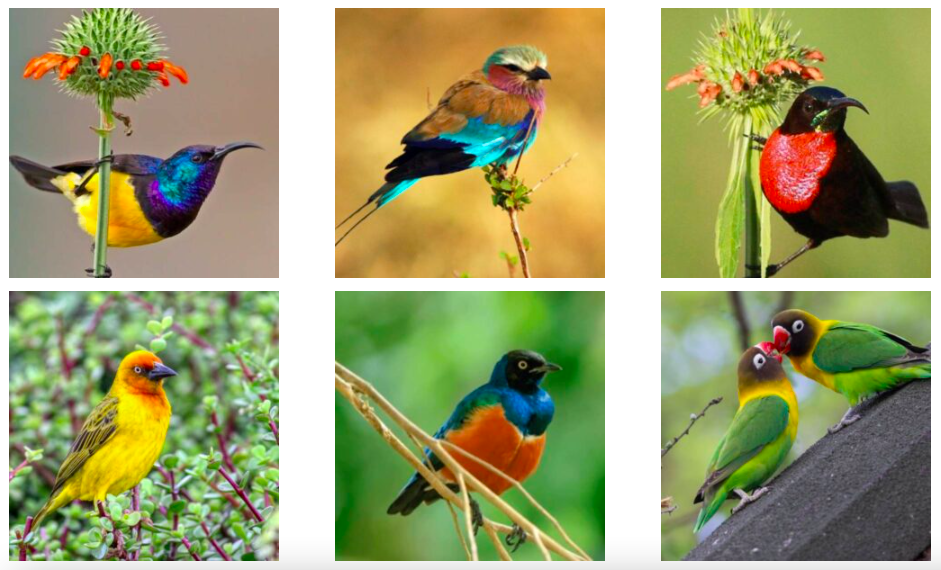
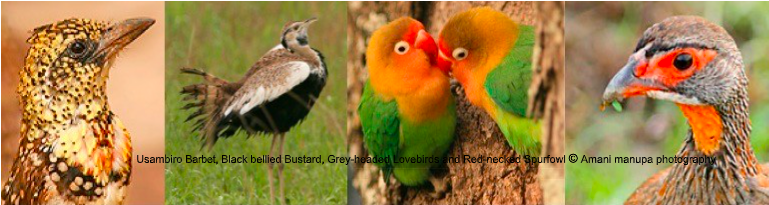
We’ll base ourselves in a conservation area that links Tarangire and Manyara National Parks. The endemic striking Yellow-collared Lovebirds are common here, while Ashy Starling and Rufous-tailed Weavers abound too. The diversity of hornbills, woodpeckers, rollers, and weavers is typical of African savannah birding. Nestled along the dramatic cliffs of the famous East African rift valley, Lake Manyara is perhaps most famous for its large concentrations of flamingos. Our lodge is set on the shoreline, in a sea of palm savanna where Secretary birds and Black- bellied Bustards patrol the grasslands.
Ngorongoro-Serengeti ecosystem
We’ll head to the vast Serengeti-Ngorongoro ecosystem, home to one of the greatest amphitheaters on earth. It is hard to do justice to the feeling of awe and privilege in these vast, timeless landscapes so rich with wildlife.
Here we will stay for a full week. First, we’ll drive up steep slopes of the Ngorongoro caldera, an ancient collapsed volcano, that looms above the plains. Looking westwards, the plains of the Serengeti stretch to the horizon and can literally teem with animals as far as the eye can see.
Olduvai Gorge
Some of our earliest ancestors have been unearthed by the Leakey family in the heart of the Ngorongoro Conservation Area. Here lies the reconstructed footprint of our earliest ancestors and the world-famous archaeological site of Olduvai Gorge. It adds a sense of time and respect to think that the spectacle that stretches out in front of us has been going on for countless generations.
Ndutu
As we drive into the open plains, we’ll pass areas where wildebeest migrate through, stretching from horizon to horizon. It is almost impossible to describe the sense of energy that one gets surrounded by these hordes of grunting animals and the predators that follow. The herds are dominated by Blue Wildebeest, also known as Brindled Gnu, but also contain vast numbers of Plains Zebra and Thompson’s Gazelle. The vulture watching is excellent here, with highlights being the huge Lappet-faced Vulture and the scarcer Rueppell’s Griffon.
We’ll stay two nights in the area of Ndutu, known for its wildlife concentrations. Ndutu is an excellent base to explore the southern short-grass plains and their associated herds of animals.
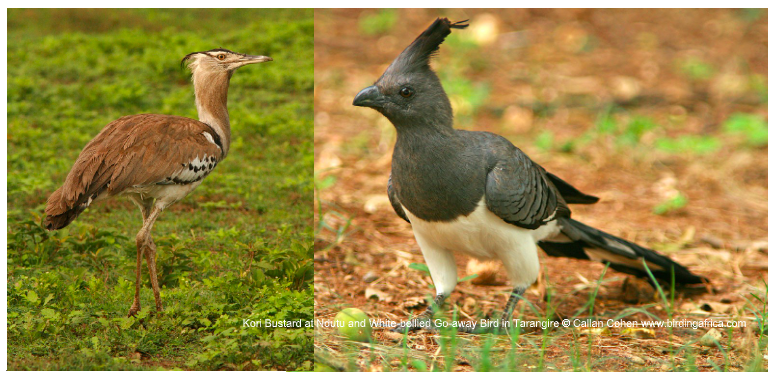
Kori and Hartlaub’s Bustards, Pallid Harrier, and Caspian Plover are just some of the birds we’ll encounter on the plains. Endemic Serengeti birds are common all around our accommodation, with Fischer’s Lovebird breeding in tree cavities along the walkways, and Grey-breasted Spurfowl displaying early mornings in front of our rooms. The nearby Lake Masek is excellent for
waterbirds. If we’re lucky, we might even see cheetahs chasing Thompson’s and Grant’s Gazelles across the open plains. We’re certainly likely to see a pride of engorged lions, lazily scattered around the previous night’s killings, while vultures, hyaenas and jackals all wait for their opportunity to get some scraps.
Serengeti
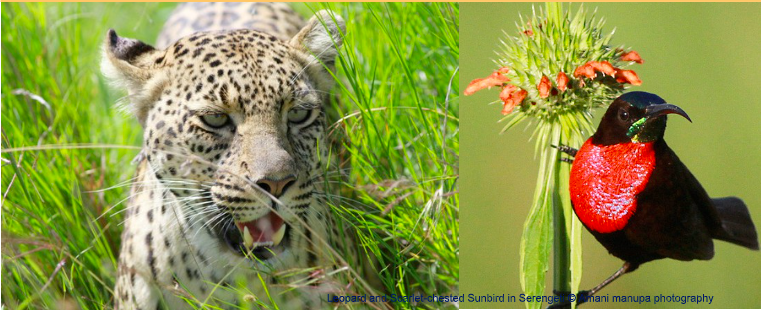
We’ll head northwards to Seronera in the central Serengeti. There are more trees here, offering a larger diversity of birds and our best chance of spotting a Leopard. Usambiro Barbet, Superb and Hildebrant’s Starlings, Silverbird, Ruaha Red-billed Hornbill, and Grey-headed Silverbill are just some of the birds that we’ll encounter here. We’ll explore the area’s riverine loops, game drives, and rocky kopjes. If we’re lucky, we’ll even encounter the little-known Karamoja Apalis, and possibly the family groups of the Grey- crested Helmet shrike. Their floppy crests are definitely outdone by Long-crested Eagle, just one of the eagles we hope to encounter.
Ngorongoro Crater
The rim of the crater is a completely different habitat to the grasslands below and is cloaked in forest and heathlands where we’ll search for Schalow’s Turaco and Golden- winged Sunbird. However, it is the crater floor that provides a natural sanctuary for the wildlife within and has become so famous. It is also the only reliable place in East Africa to see Black Rhinoceros, but the whole place is like a microcosm of Africa, with a good population of game animals, and lion and cheetah. The small lakes inside the crater hold a selection of Greater and Lesser Flamingos, storks, and plovers. An excellent selection of raptors, such as Augur Buzzard, may be seen. We’ll stay a night on the crater rim before descending the next morning to explore.
Return to Arusha
Finally, when our time has come to retrace our steps, our journey will conclude eastwards to descend the Ngorongoro Crater rim through the lush forests, looking for our last views of turacos and Blue Monkeys in the tall canopies overhead. We’ll zigzag down to the Lake Manyara escarpment and back at Arusha, we’ll enjoy a relaxed lunch before we check in for our flight past Mount Kilimanjaro and back home.
Practical details
Fitness & Health
This tour includes short strolls around the lodge grounds on relatively flat terrain. Elsewhere, the presence of wild animals may preclude excursions on foot, so we travel by safari vehicles.
Vehicles. We travel in open-roof safari vehicles. Each participant has a window-seat.
Accommodation
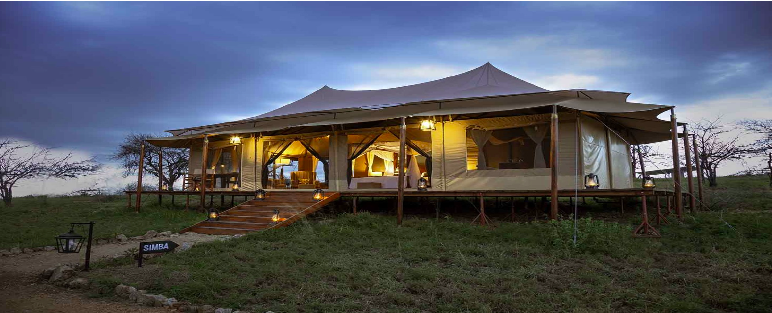
We’ll stay in hand-picked, comfortable to excellent safari lodges, hotels, and permanent tented camps as close to the best birding areas as possible. Rooms have private facilities with hot showers.
Meals and drinks
Meals are Western-style, with a hint of French and African influence. Please advise if you are a vegetarian and what foods you enjoy, so that we can cater to you. Water is not safe to drink, so we supply free bottled water in the vehicle, which you can take to your rooms in the evening for drinking.
Tour focus
Our Northern Tanzania migration safari blends the very best that East Africa has to offer. The forests, lakes, and savannas of East Africa teem with birds, including a suite of Serengeti endemics. We’ll also focus on mammals as our tour is planned to coincide with the great Wildebeest migration through the central Serengeti, we’ll stand a good chance of finding many of the region’s predators such as lion, leopard, cheetah, hyaena and perhaps even Serval.
The Serengeti is a timeless landscape, where millions of animals have migrated to green pastures under the watchful eye of tribesmen and the looming mountain Kilimanjaro. Here too lies Olduvai Gorge, where evidence of humankind’s most ancient ancestors has been found. The Ngorongoro Crater captures a microcosm among its high walls; it’s home to a high number of predators, old resident male elephants, and a unique sanctuary for the scarce Black Rhino.
We will spend a full week in the Serengeti- Ngorongoro ecosystem, one afternoon and morning in the Lake Manyara and Tarangire area, and two days in the verdant Arusha National Park.
End of our services
Package includes
- All Park fees
- Full board accommodations during safari
- Transport safari car pop up roof
- All transfers
- Drinking water during safari
- Snacks during safari
- Soft drink during safari
Package excludes
- Driver guide tips
- Personal expenses
- Visa
| Safari Package cost | $4333 p/person | For a group of 4pax |
| Single supplements | $118 per person per night |